


During this heatwave, Parisian museums and galleries attract as many curious visitors as art lovers like myself. That’s exactly what drew me in today, right after lunch: the urge to take refuge in a museum as quickly as possible! I had endless options but too few available spots. Still, there were tickets left for the Alexander Calder exhibition. And this was so great ! Like an endless feed for creativity and determination.
So, here are my photos and notes regarding this show. They are primarily intended for those who couldn’t make it to see it. I hope you enjoy them as much as I did !
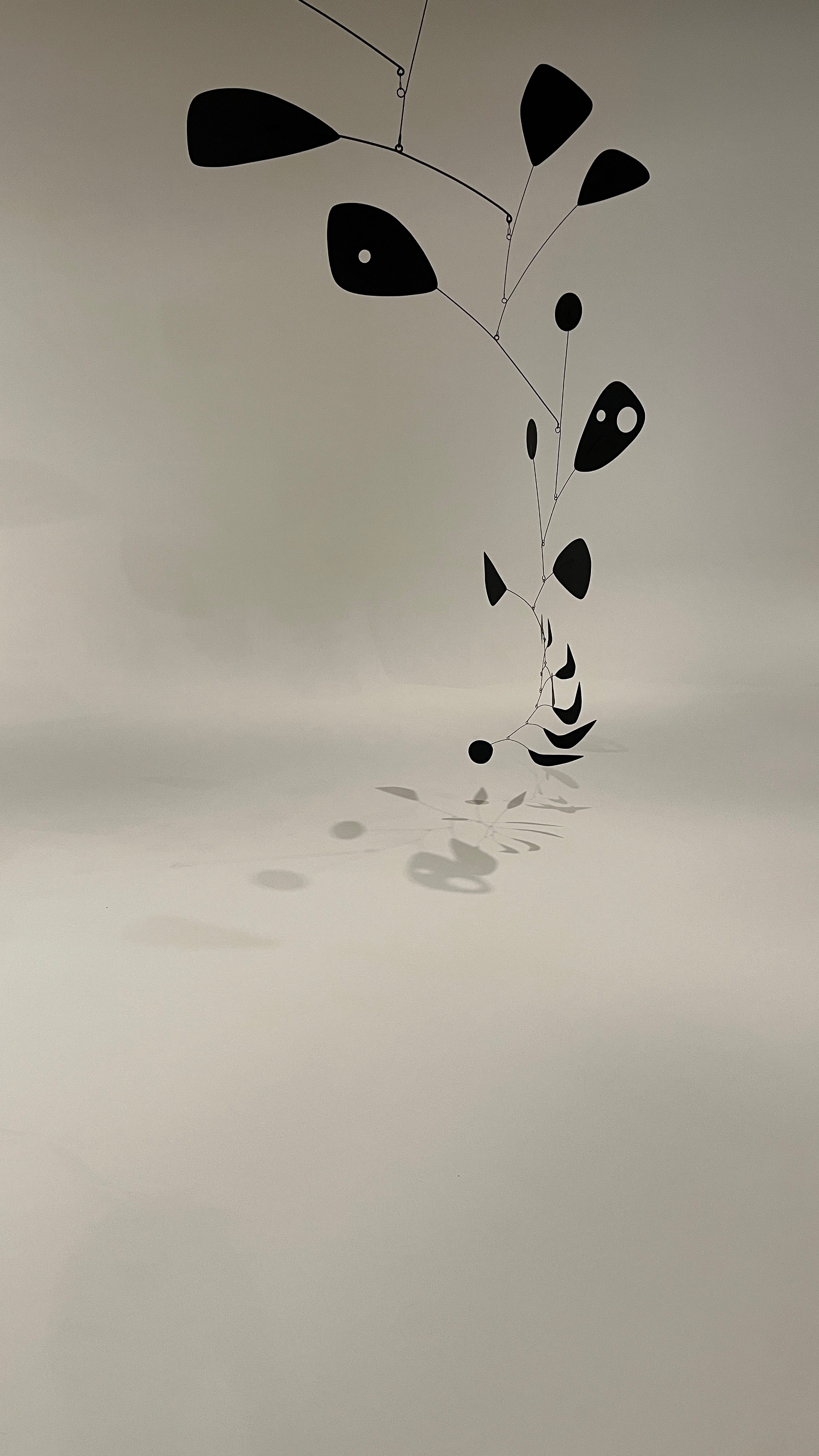
Marking the 100th Anniversary of Alexander Calder’s Arrival in Paris (1898–1976)
In 1926, Alexander Calder arrived in Paris. A century later, this retrospective fills the Fondation Louis Vuitton’s Frank Gehry-designed building and its adjoining gardens. Through a chronological and thematic approach, the exhibition traces the evolution of his work and its major milestones, from the interwar period to the final creations of one of the 20th century’s most celebrated sculptors.
In the first galleries (1, 2, 3), a significant space is dedicated to the exceptional presentation of Cirque Calder (1926–1931). This performance—what we’d now call performance art—contains the seeds of his future achievements. Next come the “drawings in space”: the weightless wire figures and portraits created by the man known as the “King of Wire.” Then, in 1930, his shift toward abstraction and his quest for a “new possibility of beauty,” one that embraced movement—synonymous with the exploration of a fourth dimension: time.
In 1931, Marcel Duchamp coined the term “mobiles” to describe Calder’s sculptures. Initially operated manually or mechanically, they were later brought to life by a simple gust of air. Calder defied categorization. After deciding to “work in the abstract” following his visit to Piet Mondrian’s studio, this friend of Joan Miró, Fernand Léger, and Jean Arp was also exhibited by the Surrealists.
Calder returned to the United States in 1933, where he continued to develop new forms—both mobile and fixed—unrestricted by materials. His 1943 retrospective at MoMA (New York) established him as a master of modern art. In 1946, after World War II, he returned to France, where Jean-Paul Sartre described his sculptures as “strange creatures, midway between matter and life” (Gallery 4).
From 1953 onward, Calder worked between his studios in the United States (Roxbury, Connecticut) and France (Saché, Indre-et-Loire). On the top two floors of the Fondation, the exhibition showcases works of all scales, from portable jewelry (Gallery 6) to monumental pieces (Gallery 10). All are extraordinary: Gongs that emit sounds (Gallery 5), Constellations climbing the walls (Gallery 7), fantastical Critters (Gallery 11), and suspended mobiles—the work of “the sculptor of wind” (Gallery 9)
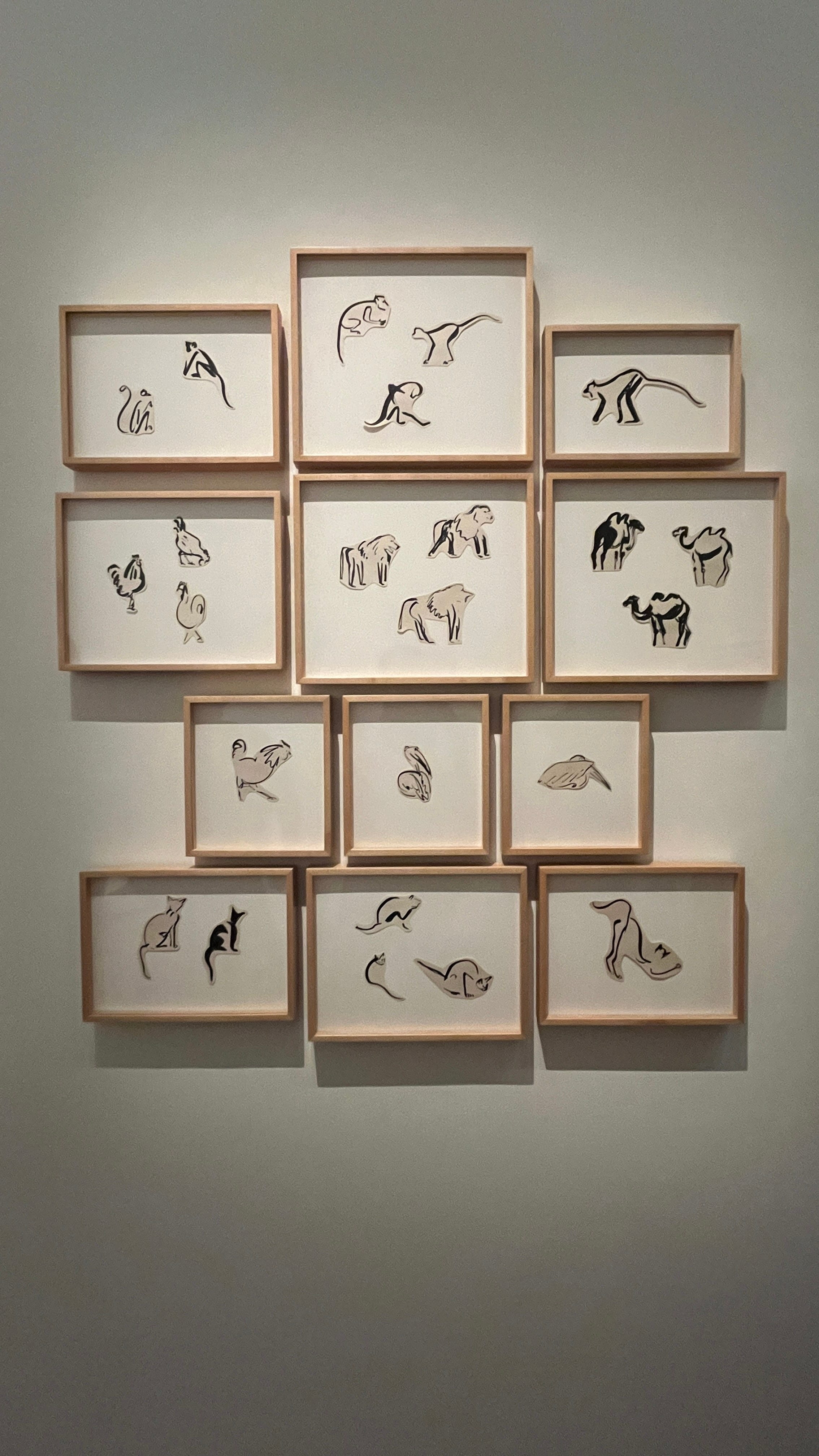
In 1925, while still enrolled at the Art Students League, Calder made hundreds of sketches of animals at the Bronx and Central Park zoos. The following year, 141 of them were published in his manual Animal Sketching: “Animals-_Action. These two words go hand in hand in art. Our interest in animals is connected with their habits, their food .... Their lives are of necessity active and the activities are reflected in an alert grace of line even when they are in repose or asleep. ... So there is always a feeling of perpetual motion about animals and to draw them successfully this must be borne in mind.” The sense of animals springing to life is conveyed through the striking fluidity of Calder’s brushwork. The nuance that defines the specific characteristics brilliantly conveys each animal’s uniqueness.
